An apostolic exhortation is a teaching document from the pope, which often aims to exhort (encourage) a particular virtue or activity. Like many papal encyclicals, apostolic exhortations have often developed themes of the Church’s social teaching.
Besides Laudate Deum, Pope Francis has written five exhortations so far in his papacy, on the joy of the Gospel, love in the family, everyday holiness, on young people and the Church in the Pan-Amazonia. Three of these exhortations were written in response to Church Synods.
The ecumenical Season of Creation closes on 4 October, the Feast of St Francis of Assisi. Pope Francis has taken inspiration from this saint throughout his papacy, being the first to adopt Francis as a papal name. The titles of his two encyclicals, Laudato Si' and Fratelli Tutti, are both taken from St Francis' writings, singing praise to the Creator for his works and encouraging the Franciscan brothers and sisters in love for each other and for all living creatures.
St Francis' life and vision for his followers epitomises the humble care for sister earth and passionate concern for outcasts that Pope Francis believes is required to rise to the challenges afflicting our world today.
The next stage of the Synod on Synodality also began on 4 October 2023, with participants gathering at the 16th ordinary general assembly of the Synod of Bishops. As the process of reflecting on what emerged from the synodal listening process in the global Church begins, Laudate Deum once again highlights our current global context - one of senseless war on nature and our failure to address the human roots of the social and ecological crisis.
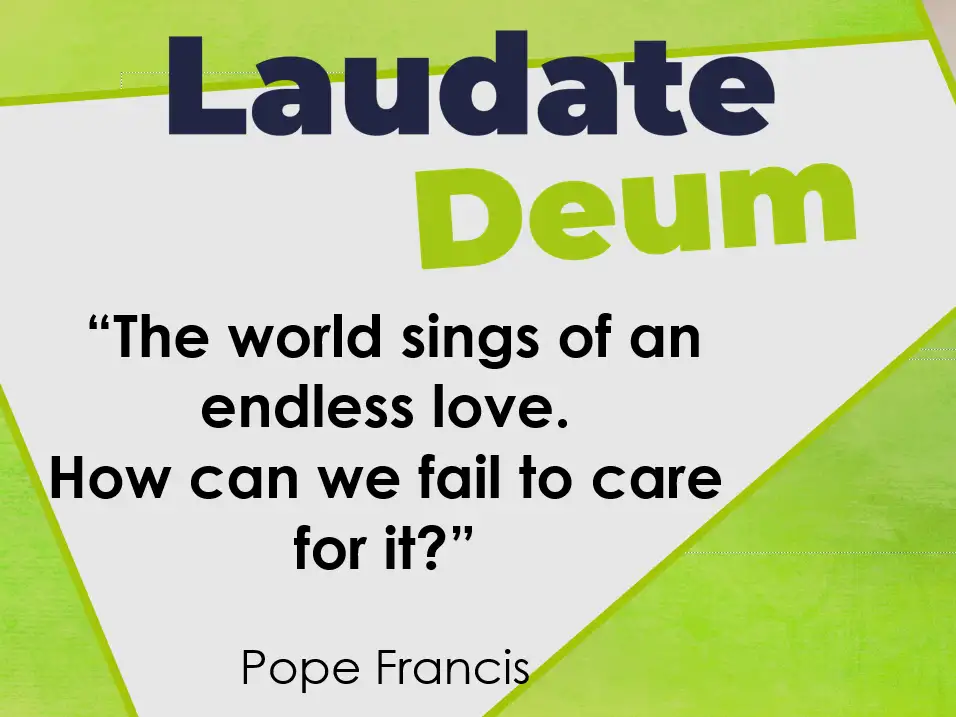
Laudate Deum means "Praise God".
This exhortation has been called a follow up to Laudato Si’ and the title reflects this. Like Laudato Si' this new document reminds us of the words of St Francis' prayer-poem, the Canticle of the Creatures, which praises God by praising God's creation.
Pope Francis states specifically that the title of this letter is “Praise God” because “when human beings claim to take God’s place, they become their own worst enemies.” (#73) By this he means that when we seek power for its own sake we damage both ourselves and the planet. Power should be used to create a better world for all.
In Laudato Si' - On Care for our Common Home, Pope Francis urged society to move away from the myth of perennial progress at the expense of the earth's resources.
Instead, we need a new definition of progress rooted in “integral ecology”, recognising that “everything is connected” and hearing both “the cry of the earth and the cry of the poor.” Laudato Si’ calls for all people to dialogue in society about how best to tackle the global issues we face.
Read our Laudato Si' explainer to find out more.
The global pandemic was a trauma and shock to world order that, in Pope Francis’ words at the beginning of Fratelli Tutti, “exposed our false securities”. Yet, with the direct health threat under control, politics and economic defaulted to business as usual.
As the pope highlights in Laudate Deum (44-52), representatives from 190 countries have met annually since Laudato Si’ was published to address the issue of climate change. While there has been some progress, the principles agreed on have not yet been implemented, and national interests are too often placed before the common good.
Laudate Deum is an urgent call to tackle the climate crisis, recognising that time is running out. And irreversible damage has already been done.
In this letter Pope Francis states that the climate crisis is real and cannot be denied. It is caused by human activity.
But the pope cautions against seeking only technological solutions, noting that although we have more and more tools to manipulate the world, we are still failing to protect the environment from destruction. The more we seek to increase power for its own sake, the less we use our power to protect life. As he states, “Not every increase in power represents progress for humanity.” (#24)
At the same time, he says, economic powers are not interested in solving the problem, because they want “the greatest profit possible at minimum cost” (13). This pursuit of the greatest profit possible at minimum cost makes caring for our common home impossible.
We need political change on a national and international level. While Pope Francis states that individual actions and efforts to minimise waste are important, he also recognises that they are not enough. We are called to continue to transform society through our individual, family and community actions, but also to call on those in power to take urgent action.
Pope Francis is clear that we all have a role to play, pressurising the sources of power and demanding change. He calls us all to be involved and particularly urges that COP28, the next round of important UN negotiations on climate change, needs to be a historic event, with binding forms of energy transition. For the sake of the future of our children we must take action.
Despite the gravity and urgency of the situation we face, Pope Francis reminds us that we must continue to hope, because to “‘say there is nothing to hope for... would mean exposing humanity, especially the poorest, to the worst impacts of climate change." (#54)